

Last verified: September 2026. This article is for informational purposes only and is not a government source. Always confirm current requirements with the Embassy of Suriname or VFS Global before booking travel. About the author: James T. has covered South American travel regulations since 2019 and personally applied for a Suriname Entry Fee during a Paramaribo trip in 2024. The team verifies all data quarterly against government announcements.
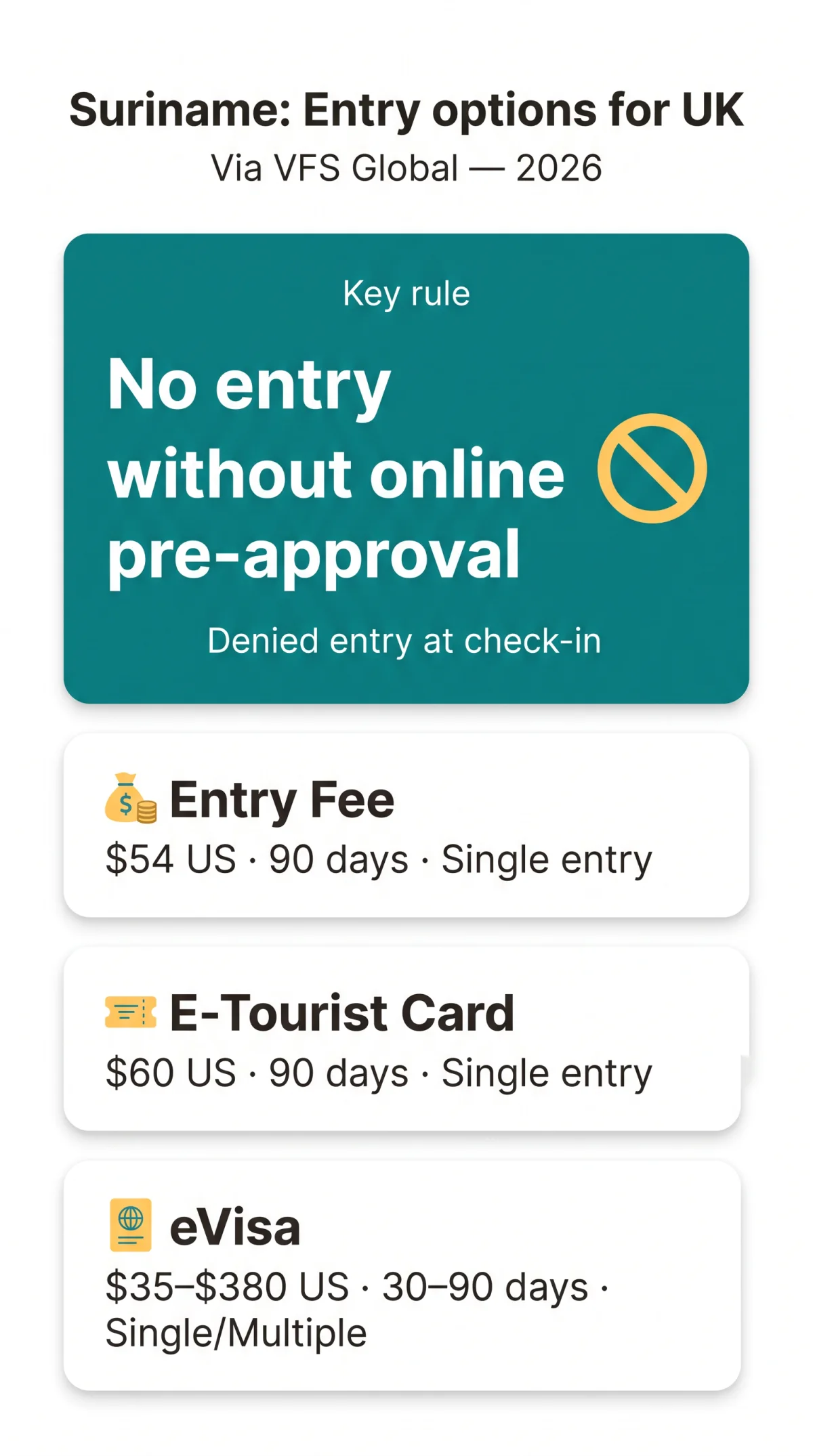
Suriname permanently discontinued the Visa on Arrival. In 2026, UK passport holders must choose between a $54 Entry Fee, a $60 E-Tourist Card, or an eVisa. All applications are processed online before departure; arriving without digital pre-approval results in denied entry. The Visa on Arrival ended in 2022, replaced by a digital process via VFS Global. Applicants must plan their trip in advance. To ensure a smooth journey, UK citizens must submit applications using OCR-technology for passport uploads and pay the mandatory service charge online. The processing time requires applying early, and travellers must complete the Immigration and Customs Form (ICF) up to 3 days before flying. This Suriname eVisa vs Visa on Arrival comparison helps you choose the right digital route.
Can You Still Get a Visa on Arrival in Suriname in 2026?
The Suriname eVisa vs Visa on Arrival comparison reveals a stark reality for 2026: the Visa on Arrival is permanently discontinued. The discontinuation is based on Suriname’s Immigration Decree (Staatsbesluit) No. 2022-12. The old on-arrival Tourist Card ended on January 1, 2020, and the on-arrival Entry Fee ceased on October 1, 2022. UK travellers arriving at Johan Adolf Pengel International Airport without prior online approval face immediate denied entry.
January 1, 2020
On-arrival Tourist Card ended
October 1, 2022
On-arrival Entry Fee ceased – Visa on Arrival permanently discontinued
2026
Three online-only entry options via VFS Global
⚠️ IMPORTANT: Immigration rules can change with little notice. As of September 2026, this information is accurate, but check the VFS Global portal 48 hours before departure. When looking at a Suriname eVisa vs Visa on Arrival comparison, remember that turning up without a pre-approved digital visa guarantees rejection.
What Are Your Three Options for Entering Suriname in 2026?
Since the Suriname eVisa vs Visa on Arrival debate is settled, UK travellers have three online-only entry options processed exclusively via the external authorised partner, VFS Global. Standard UK tourists staying under 90 days generally only need the $54 US Entry Fee. Understanding the Suriname eVisa vs Visa on Arrival shift means selecting the correct digital replacement below.
| Option | Total Cost | Max Stay | Entry Type | Apply Where |
|---|---|---|---|---|
| Entry Fee | $54 US | 90 days | Single entry | VFS Global Portal |
| E-Tourist Card | $60 US | 90 days | Single entry | VFS Global Portal |
| eVisa | $35 – $380 US | 30-90 days | Single / Multiple | VFS Global Portal |
Suriname eVisa vs Visa on Arrival: Cost, Speed, and Ease Compared
The Suriname eVisa vs Visa on Arrival comparison highlights a shift from last-minute convenience to pre-approved security. The modern digital system requires UK applicants to apply online 3 to 7 business days in advance. A detailed Suriname eVisa vs Visa on Arrival comparison shows a clear pricing structure. UK citizens entering for standard tourism pay a flat $54 US Entry Fee.
The E-Tourist Card costs $60 US (a $40 base plus a mandatory $20 service charge). The standard eVisa for business or study allows a stay of up to 30 days (single-entry) or 90 days (multiple-entry), ranging from $35 to $380 US (a $15 to $360 base fee plus the $20 service charge). British travellers using UK bank cards should anticipate foreign transaction fees for USD billing.
How to Apply for a Suriname eVisa Online
Apply exclusively online via the external authorized partner VFS Global at https://. A detailed Suriname eVisa vs Visa on Arrival comparison for 2026 shows this digital route demands strict adherence to steps before departure. British travellers must prepare their paperwork well in advance. Follow these steps for the Suriname eVisa vs Visa on Arrival modern alternative:
Access the VFS Global portal
Start the application online
Upload your passport data page
Use the required OCR-technology
Submit payment
Allow 3-7 business days for standard processing
Receive your approved document
Delivered via email
Suriname eVisa Documents and Processing: What UK Travellers Need to Know
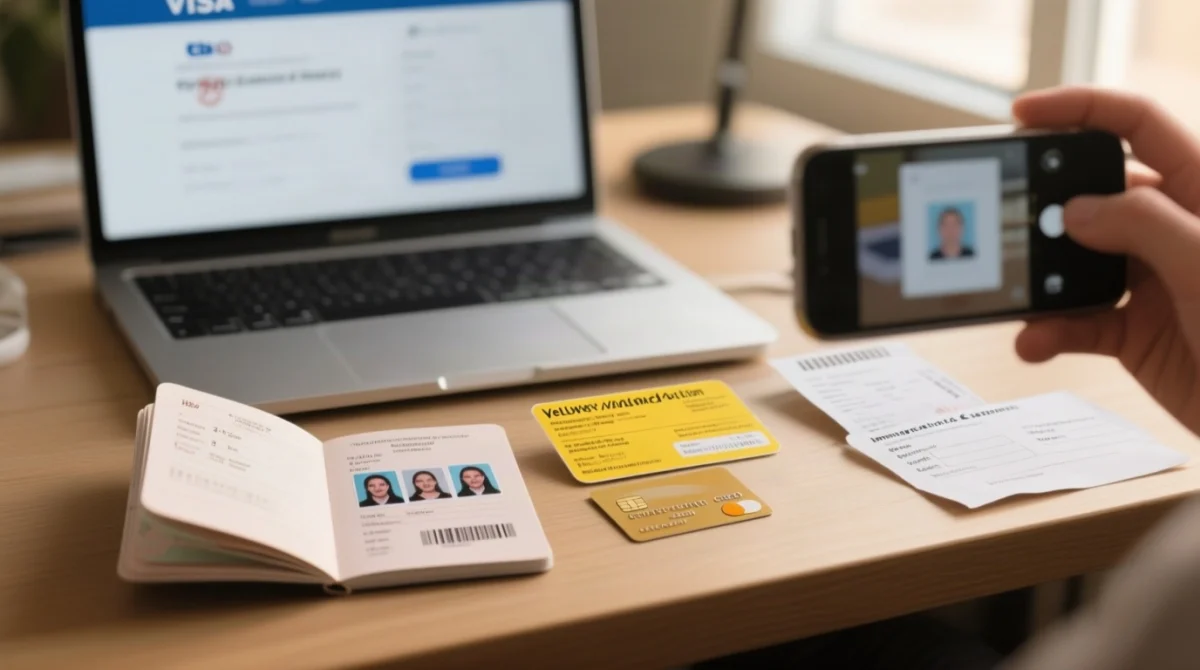
The Suriname eVisa vs Visa on Arrival transition means strict document checks happen before you fly. UK applicants need a passport valid for at least 6 months after arrival. You must also attach a 3x4cm photo, proof of onward/return ticket, and a yellow fever vaccination certificate if arriving from a risk area.
Furthermore, all UK visitors must complete the Immigration and Customs Form (ICF) via https:// up to 3 days (72 hours) before both arrival and departure. Overstaying is illegal, and extensions require leaving and re-entering. Understanding the Suriname eVisa vs Visa on Arrival rules ensures you meet these strict processing requirements.
Border Rules: The ICF, Land Crossings, and Airline Boarding
The Suriname eVisa vs Visa on Arrival comparison highlights a crucial modern shift: airlines will deny boarding if you cannot present an approved digital entry document at check-in. Although the system is electronic, border guards frequently request a printed paper copy of your eVisa or Entry Fee receipt as a backup.
This Suriname eVisa vs Visa on Arrival digital reality applies everywhere; modern digital approvals are fully valid at the South Drain (Guyana) and Albina (French Guiana) land border checkpoints.
Frequently Asked Questions: Suriname eVisa vs Visa on Arrival
Who should choose the eVisa over Visa on Arrival?
Choose the eVisa for business, study, or work (multiple-entry allowed). Standard tourists under 90 days need only the $54 Entry Fee.
What is the difference between eVisa and Visa on Arrival in Suriname?
The Visa on Arrival is obsolete. The modern eVisa requires applying online via VFS Global, paying a service charge, and waiting 3-7 business days.
Do I need a printed copy of my Suriname eVisa?
Yes, border guards and airlines often require a printed paper backup alongside your completed Immigration and Customs Form (ICF).
Can I apply for a Suriname eVisa through VFS Global?
Yes, all online entry options are processed exclusively through the VFS Global portal using OCR-technology.
What is the Suriname e visa processing time?
The standard processing time is strictly 3-7 business days, with no emergency expedited options available.
Are Suriname eVisas valid at land borders like Guyana or French Guiana?
Yes, approved eVisas and Entry Fees are fully valid at the South Drain and Albina overland border crossings.
What happens if my Suriname visa on arrival is denied?
You cannot be denied a Visa on Arrival in 2026 because it was permanently discontinued; airlines will deny boarding without pre-approval.
Can I get a refund if my Suriname eVisa application is rejected?
No, all costs, including the base government fees and the mandatory $20 VFS Global service charge, are strictly non-refundable.
How current is this information?
This article was last fact-checked against the official VFS Global portal and the Embassy of Suriname in September 2026.